Fun fact: fusible beads have been around since the late 50s, making them nearly 60 years old today! And we have Sweden to thank for it!
Although beads made out of synthetic materials, like ceramics or glass, have been around for quite a while, the plastic toy kind, made by chopping plastic tubes into short pieces, was introduced in 1958 by the Munkplast AB company in Munka-Ljungby, Sweden. Referred to at that time as a type of Indian bead, they were originally sewn together to form ribbons. Today, Munkplast AB is best known for its fuse bead brand ‘Nabbi’.


The pegboard for bead designs was patented in 1962 (granted 1967) by Gunnar Knutsson in Vällingby, Sweden, as a therapy for elderly homes. It wasn’t until much later that the pegboard gained popularity as a toy for children. The bead designs were either glued to cardboard or Masonite boards and used as trivets. Later, when the beads were made of polyethylene, it became possible to fuse them with a flat iron.

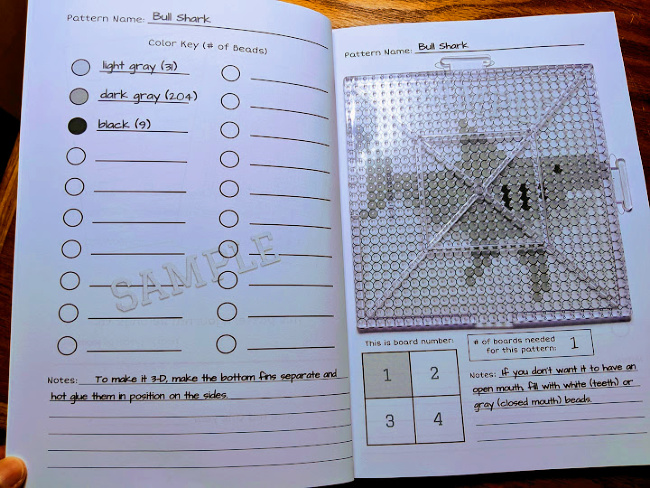
Today, fusible beads are made with a food grade plastic, i.e. low-density polyethylene, which is the same as what’s found in plastic bags or some bottles. Interestingly, Nabbi just released a line of biodegradable fuse beads. Way to reduce that carbon footprint! There are idea books filled with hundreds of designs purposely made large enough for clear pegboards to be placed over them and created that way. Of course, the creator is always welcome to simply eyeball it.
Since their initial inception, various brands of fuse beads have popped up, including Sweden’s ‘Nabbi‘, IKEA’s ‘Pyssla‘, China’s ‘Artkal‘, the UK’s ‘Hama‘, Walmart’s (crappy) ‘Melty beads‘, and the ever-popular American brand ‘Perler‘. Next time, we’ll discuss some of the differences in quality between these brands and why it matters!

 Fun with Fuse Beads